Article Link:
The primary focus of an upcoming project I am working on is comparing whether certain medium presentation mediums of a moral dilemma affect the moral decisions of those confronted with morally challenging scenarios. The question is a primarily rhetorical one: does the method the story is told by effect the moral persuasiveness of the story. Within the field of rhetoric, similar considerations have been made by specifically changing word selection in certain aspects of a story. A 1996 study by Lewis Petrinovich and Patricia O'Neill (Journal of Ethnology and Sociobiology), studied exactly this. By examining the differences in the decisions of groups posed with the trolley problem first posed by Phillipa Foot when the moral dilemma presented at conclusion of the problem was with either "saving" a number of workers or "killing" the reciprocal number of workers on the alternate track.
Moral philosophers call differences in wording "framing effects." This study was designed to specifically examine the efficacy of such effects. The study was conducted in two parts, the first of which dealt specifically with the trolley problem. The presentation of the problem was presented eight different narrative presentations, or "dimensions," coded both for the varying presentation factors and the "kill-save" variation. The study found that people were far more likely to agree with statements worded with the "save" variation.
While this study is fairly limited in the range of difference in presentation--or at least compared to comparing a video game to a written description--but it demonstrates that the differences can be profound in how the moral problem is conceived by the participant. My expectation is that similar differences would exist in any medium. For example, camera angles in a film presentation may affect the moral disposition of the viewer when presented with what may be the identical moral scene. This intra-medium analysis does not, in my opinion, make it impossible to examine inter-medium differences. Ultimately, the most predominant factor of the moral dilemma presented is the dilemma itself. Although the "framing effects" may 'nudge' moral intuitions to one side or other, the essential aspects of the morally reasoning process, once reflected upon, remain the same. The is, however, an immense value in examining, as this study did, the nature of the 'nudge.'
References:
Petrinovich, Lewis and O'Neill, Patricia. (1996). Influence of wording and framing effects on moral intuitions. Ethology and Sociobioiogy 17:145-171. New York, NY: Elsevier Science Inc.
Showing posts with label ENGL 662. Show all posts
Showing posts with label ENGL 662. Show all posts
Tuesday, November 9, 2010

Monday, November 1, 2010
Research: The Rhetoric of Video Games
Article Reviewed: The Rhetoric of Video Games by Ian Bogost
One of challenges of bringing the study of a video games into the realm of academic discourse is attempting to define the academic ontology that video games can be studied under. Computer science is an obvious choice, as are fields that study human computer interactions (i.e. psychology, neurology, computer engineering), media studies, and the effects of video games on children. Philosophers and rhetoricians also seem to have a stick in this fight, examining games as some sort of combination of narrative medium and rhetorical play. One of the more seminal arguments for game under this interpretation is presented by Ian Bogost in "The Rhetoric of Video Games."
Bogost argues that video games present a new form of rhetoric, "procedural rhetoric," that, in the case of video games, is a subset of digital rhetoric and visual rhetoric. Illustrating his point by citing games such as Rockstar Studios Bully,"...models the social environment of high school through an expressive system of rules, and makes a procedural argument for the necessity of confrontation;" and Will Wright's Spore, which "subtly arguing through its game play that the spread of life in the universe is most likely caused by sentient beings transporting other creatures from star to star."
I find that there are three profound implications to Bogost's essay, two that he names and one that he does not. First, as Bogost writes, "...playing video games is a kind of literacy... that helps us make or critique
the systems we live in." Second, "By teaching...arguments in procedural form—even simple ones like models of their everyday life—video games can become a carrot medium for both programming and expression." The final implication, that Bogost does not overtly mention, but can be derived from his work, is that video games merit the same forms of study and criticism as other forms of rhetoric. Video games are just as susceptible to critical inquiry as literature or film and gaming elements, like literary elements (i.e. syntax, metaphor) or visual elements (i.e. composition, color), are just as due for analysis and study. Conventions of genre and form in video games should and will become principle to cultural and social understanding of the medium.
For my own research, I found it interesting that Bogost on multiple occasions cited Plato and his use of allegory to make rhetorical arguments about behavior and perception. To contrast and place video games next to classical forms of rhetorical discourse says a great deal about what video games may be capable of in terms of "education" in the most classical sense of the word. That said, of course, I find no closer real world analog to Plato's Cave Allegory than the contemporary living room, with its large screen TVs, XBOX's, Blue Ray players, and 24/7 cable programming feeds. The more things change, the more they stay the same.
References
Bogost, Ian. (2008). The rhetoric of video games. In K. Salen (Ed.), The Ecology of Games: Connecting Youth, Games, and Learning (117-140). Cambridge, MA: The MIT Press.
Monday, October 4, 2010
The Trolley Problem

"Suppose you are the driver of a trolley. The trolley rounds a bend, and there come into view ahead five track workmen, who have been repairing the track...[Y]ou must stop the trolley if you are to avoid running the five men down. You step on the breaks, but, alas, they don't work. Now you suddenly see a spur of track leading off to the right. You can turn the trolley onto it and thus save the five me on the straight track ahead. Unfortunately...there is one track workman on that spur of track. He can no more get off the track in time than the five can, so you will kill him if you turn the trolley onto him.
Is it morally permissible for you to turn the trolley?" (Thomson I).
And such was my introduction to the question that Phillipa Foot first posed when addressing the question of abortion in 1978 in her The Doctrine of Abortion and the Doctrine of the Double Effect. Although the trolley problem's ties to Foot and the subject of her original essay have been largely forgotten, the type of thought experiment posed by the question has become a critical feature of any number of fields of study. Judith Thompson, an MIT professor and Foot's contemporary expanded on the problem considerably, crafting all sorts of morally frustrating variations. Law schools soon latched on as well and the question is often posed to first year law students when the question of 'what is morally just versus what is morally permissible' is initially posed (perhaps to hasten the moral cynicism that all law students eventually succumb to).
Study of the trolley problem is currently of interest to neuroscience, as morality thought experiments, when posed to populations observed by fMRI scanners, have revealed how the brain performs moral reasoning and, more interestingly, how members of different gender, ethnic, and social groups actually may process such question differently than other populations. At the forefront of this type of research is a Harvard researcher named Joshua Greene who runs that university's Moral Cognition Lab. (See exemplar studies below.)
Similarly, psychology has found all interesting uses for variations of the trolley problem. Of recent note was a study released by Cornell research psychologist David Pizarro, who used varying nouns to implicate race distinctions in the various descriptions of the problem, revealing telling inclinations of certain political groups towards favoring one ethnic group over another. (See Wired.com summary here, article cited below.)
Those interested in these fields will find each discipline’s study of the problem fascinating in its own right, but the trolley problem and its frustrating rhetorical implications has come to represent thought experiment par excellence of our contemporary age.
(Now if we could just manage to convey the same sort of thing with a video game...)
References:
Ditto, P.H., Pizarro, D.A., & Tannenbaum. (2009). Motivated moral reasoning. Psychology of Learning and Motivation, 50, 307-338. ![http://www.sciencedirect.com/scidirimg/clear.gif]() doi:10.1016/S0079-7421(08)
Foot, P. (1967). The problem of abortion and the doctrine of double effect. Oxford Review, 5. Retrieved from http://www2.econ.iastate.edu/
Greene, J.D., Nystrom, L.E., Engell, A.D., Darley, J.M., & Cohen, J.D. (2004). The neural bases of cognitive conflict and control in moral judgment. Neuron, 44(2), 389-400. doi:10.1016/j.neuron.2004.09.
Greene, J.D., Sommerville, R.B., Nystrom, L.E., Darley, J.M., & Cohen, J.D. (2001). An fMRI investigation of emotional engagement in moral judgment. Science 293, 2105-2108. doi: 10.1126/science.1062872.
Thompson, J.J. (1985). The trolley problem. Yale Law Journal. Retrieved from http://amirim.mscc.huji.ac.il/
Tuesday, September 21, 2010
ENGL 662 Post II: Past as Prologue (A metaphor examination)
Because of last week’s reading from Nayar, I had feminism and depictions of females with reference to technology on the brain. Likewise, Halo: Reach came out last week, so I have video games on the brain as well. My wife does not think so highly of my video game habit--her words: “I hate them [video games]”--so I looked to the past to find out why this might be. Recalling my youth, I went to YouTube to scrounge up old (circa 1985) commercials for Nintendo games quickly finding this gem, an advertisement for the first Legend of Zelda game. The message of this video seems pretty apparent: Video games are made for white, upper-middle class teenage boys who may or may not be nerds and/or Vanilla Ice wannabes. While I am certain that I was the target audience for this commercial when it was released, I shudder to think that I could have, at any age, been influenced by such an awkwardly pitched item.
Bad rapping is not the only thing that is going on here, however. From Nayar: “...[T]he woman’s projected and real role in the use of...technological artifacts has prompted the artifact’s development in particular ways” (p. 116). I reviewed other early video game commercials, from Atari and Sega as well as Nintendo, and in almost every case it was males playing, with women either being non-present or acting as spectators to the action. Granted, there were market forces at work here, and pre-teen/teenage boys had likely already been identified as the most likely video game players from early video game trends of the 1960’s and 1970’s (i.e. SpaceWar). Yet, I can’t help but think that these commercial set the popular tone of video and computer games being a primarily male-oriented medium all the way up to the present day. Whether incidental or intentional, the exclusion of female players from the commercials of the first generation of home video game consoles created a cultural precedent.
Of course, it’s not just males that are being given the privileged position in this commercial. Certainly, as depicted in the commercial, nerds of the 1980’s could take pride in being the subject matter experts of contemporary gaming (“You mean you haven’t played it yet!? You can play it on my Nintendo Entertainment System!”). Likewise, my “digital native” ears found especially jarring the narrator’s “...your parent’s help you hook it up.” I forget that the Regan-era power dynamics hadn’t yet adopted the concept of youth being tech savvy to the point of (rather comfortably) usurping authority. Although this is taken for granted today, the proto-hacker character that Matthew Broderick portrays in WarGames (1983) was a novel concept at the time. I remember my parents hooking my various series of video game consoles only once--the very first time because (and this was probably because I was only four and couldn’t read the instructions).
Fast forward a quarter of a century or so. A commercial exemplar from the present day is the recent campaign for Halo: Reach and it provides an enlightening contrast about where video games are today. A few glaring things stand-out. First, the “players” are gone. Segments of the commercial are even shot from a first-person perspective. Gaming has evolved into an ‘experience’, an ‘immersion’. Second, gender is non-present. There is even suggestion of female features in the wounded protagonist's face. Third, the game system is vastly de-emphasized compared to the 1980’s. Although this last point can be contributed to a change in the industry’s business model (emphasis on selling games [software] over new systems [hardware]), it is still important to recognize that the shift is contextualized visually in the presentation of the experience of gaming itself. Gone are the controllers and TV screens, the living room and couch: the fourth wall has been removed completely from the the gaming experience and thus it’s need for a rhetorical player--be it nerd or white-boy rapper.
Tuesday, September 14, 2010
ENGL 662 Post I: Orientation
The general thesis of my proposed paper idea is that video games, as a form of rhetoric, can, like other forms of rhetoric, be used to 'teach' ethical thought and decision making. As such, I have done a good deal of browsing for research and publication already done on the subject and have found some interesting sites and books.
Perhaps the best of these is a blog run by a conglomerate of Harvard professors called "Valuable Games" (http://blogs.law.harvard.edu/games/). There are a number of interesting articles here, as well as some mixed media. The most useful to me, perhaps, was a video of a lecture that Harvard law professor Gene Koo gave at MIT on the presence of ethics and morality in video games. (Video found here: http://blip.tv/file/1480114?utm_source=player_embedded). Mr. Koo gives a brief but thorough overview of ethical systems within games, starting with Classical games and quickly moving forward to Dungeons & Dragons, and then the video games that attempt to emulate some of the moral paradigms that had been embedded in the paper and pencil role playing games.
Mr. Koo also makes brief forays into ethical theory, mentioning other scholars like his Harvard colleague Steven Pinker and others who have used more traditional thought experiments in the past to examine ethical reasoning and postulating that video games can provide a similar stimulus. Of special note is his use of two illustrations: First, his 'holocaust tetris' example, which, much like Sicart (2009, MIT Press) more extensively argues, conveys--rather shockingly--that video games are very much "moral objects" and that game designers have implied moral responsibility. Second, Mr. Koo goes 'old school' rhetorical with the famous "trolley car" thought experiment. Although I think there is far more mileage in considering video games as types of thought experiments, Mr. Koo is probably being deliberate when he brings it into his presentation here.
The final portion of Mr. Koo's presentation involves a fairly standard introduction to some of the controversy involving video games as a stimulus that provides negative, violent provocations in youth. The bulk of any inquiry into scholarship involving video games and ethics tends to this sort of slant and it is ultimately unfortunate that such an alarmist--and in my opinion, which seems to concur with Mr. Koo's--misguided stance is so widely represented in academic text.
Fortunately, in addition to Mr. Koo's presentation above, I have found a number of other resources that take a far more nuanced view of the ethics video games, as well as what I have summarized above. I will discuss those further in later blog posts. That stated, Mr. Koo seems to be one of the more serious scholars on the subject of ethics in video games-- it seems like Harvard/MIT faculty are leading the way on this subject as a whole--and this presentation serves as an excellent introduction to some of the more critical issues in game studies and moral thought.
References:
Koo, G. (2008, November 18) Talk on Games Morals and Ethics. [Blog Post]. Retrieved from
http://blogs.law.harvard.edu/games/category/theory/morality-theories-of/
Sicart, M. (2009). The Ethics of Computer Games. Cambridge, MA: The MIT Press.
Friday, September 3, 2010
The Problem
 |
| Candyland: War College Edition |
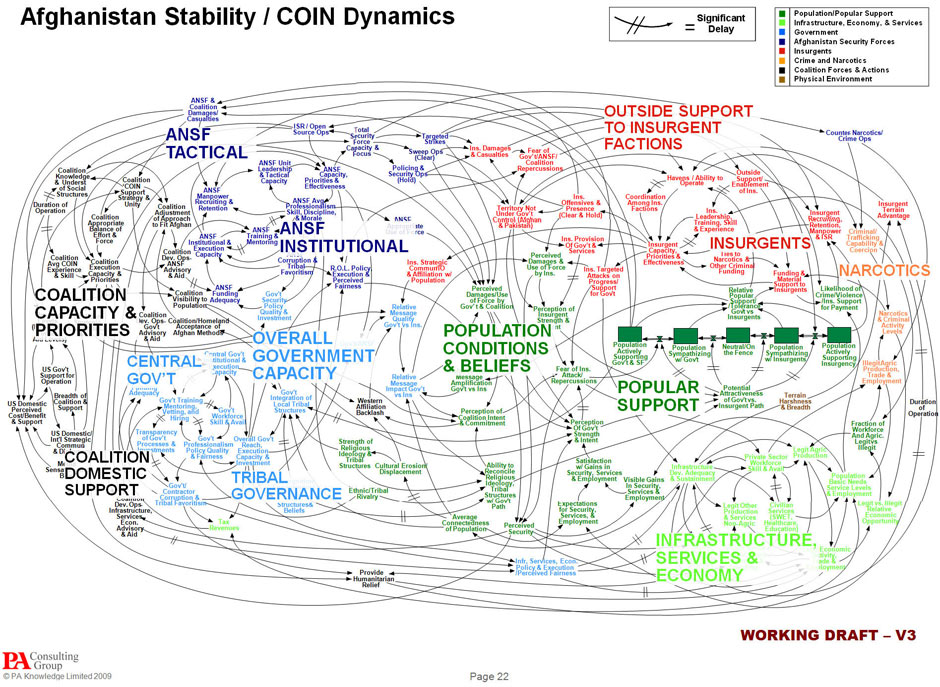
Last week, Wired's Dangerroom Blog wrote about a Army Colonel who was relieved of duty in Iraq after writing a generally unflattering article about the US military's use--or rather, mis-use--of PowerPoint. The Colonel laments, "endless tinkering with PowerPoint slides to conform with the idiosyncrasies of cognitively challenged generals in order to spoon-feed them information.” He was relieved less than 48 hours after the article hit UPI, a newswire service.
While I can't quite figure out why the colonel would choose to release this over a wire service rather than a blog or some other, less 'commercial' forum--as Wired points out, the Army (and the military in general) has been generally hands off soldier's blogs and online postings--I agree with his general conclusion. The military has developed a PowerPoint habit to the point of inanity. Rather than using it as a tool to convey information in a visual form, it has become the sole, de facto medium of communication from the Grunts on the ground and deckplate Sailors up to the general officer and Pentagon command structure.
As a student interest in the rhetorical and functional implications of various forms of electronic media, the drawbacks of relying solely on PowerPoint are obvious. Take, for example, the infamous PowerPoint slide at the top of this post. The New York Times and others have reported on the military's reliance-to-a-fault on PowerPoint and have used this leviathan slide to illustrate their point. To the credit of the flag-level Officers who view these everyday, it's obvious that they know that all nuance and many important details are stripped from the information by the data gets delivered to them in slide form, yet this does not prevent this from the being the day-to-day status quo of decision making strategists.
Two issues:
1. From my level, I am usually directed to format a slide(s) in a particular way that I know is less effective than another method I have either learned or studied. There are certain formats ("stop-lights," "quadrant-slides," etc.) that I continuously produce or see being produced that are just not the most effective way to convey information to the "chain-of-command," but this is what the CoC demands--or implies that it demands. The reliance on these slides likely derives from the lowest common denominator of PowerPoint users. Most military users suck at PowerPoint, do all or most of the PowerPoint sins, and this ineffective use has evolved into an equally ineffective culture of information flow.
I believe that it is absolutely essential to fix the culture of ineffective info flow.
2. Returning to the slide that starts this post, the slide itself is essentially accurate. But, if the "medium is the message," then it's the medium that muddles the usefulness of what is presented here. The question I'm am very much concerned with is the same one The Guardian poses: How can it be done better? Can it be done better with PowerPoint or any other tool for that matter? The Guardian posed it as an open-ended question, and seems to have received anything in the comments section of any real substance.
So, professional writers, there's our gauntlet. America needs our help.
Subscribe to:
Posts (Atom)